Inner gas membrane
A low-permeability membrane holds the CO2 and moves with the inventory. It is sealed at the base and sized for the plant's full gas volume plus operating margin.

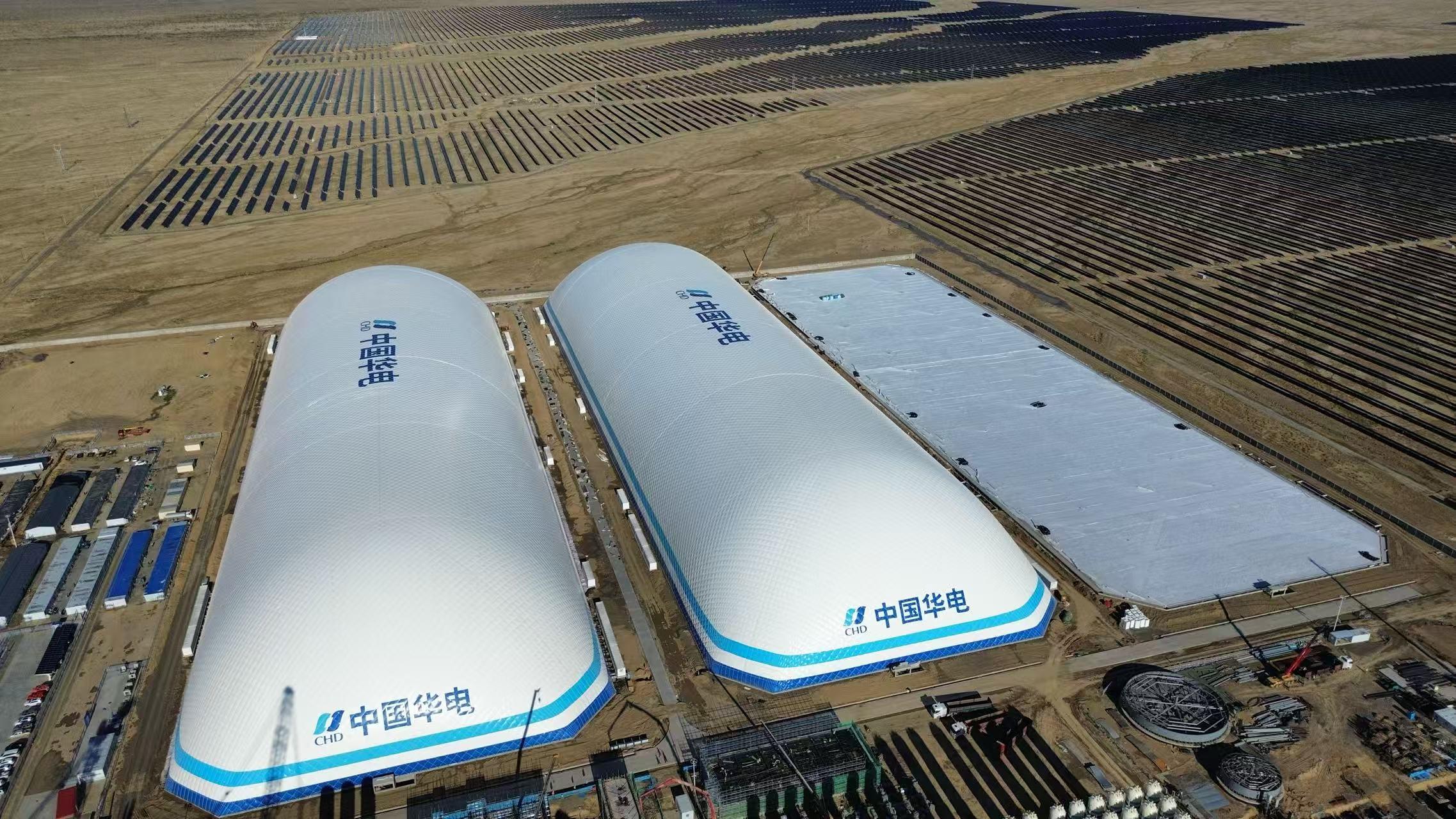
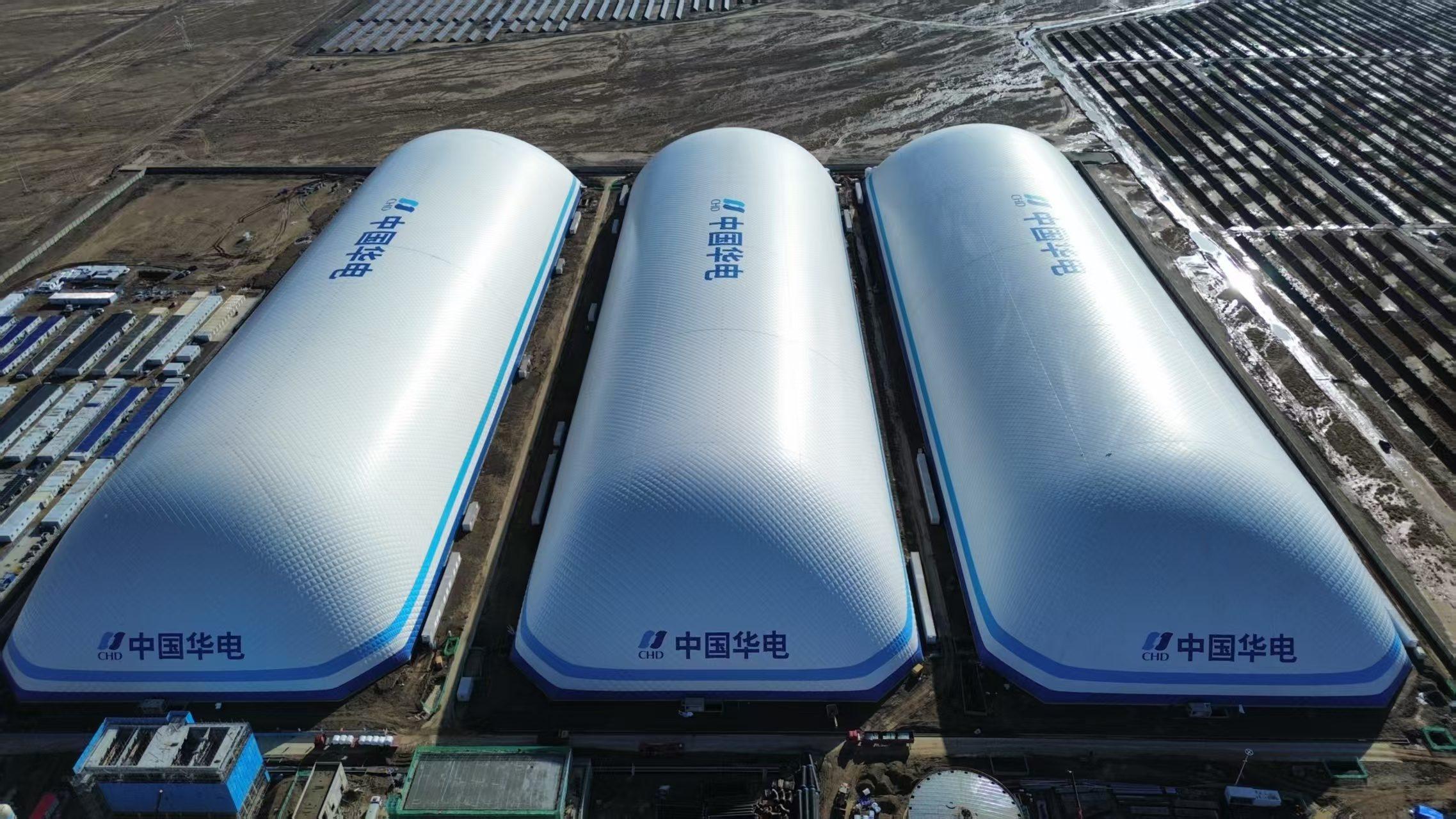
A compressed CO2 energy storage (CCES) plant holds its CO2 as a gas at near-atmospheric pressure between cycles, which takes a very large, gas-tight space. Broadwell builds that space, working with our partner Exax Energy Tech.
Exax Energy Tech is Broadwell's strategic partner in compressed CO2 energy storage. Each partner does what it does best, and the plant and its domes are designed together from the start.
The process plant
Exa Energy Technology (Shenzhen) Co., Ltd.
Develops the CCES technology and process plant:
The gas storage domes
Broadwell Air Domes in North America
Designs, manufactures and supplies the gas storage domes that hold each plant's CO2:
A CCES plant moves a fixed inventory of CO2 between two states. Charging uses electricity to compress the gas and store it as a liquid in pressure vessels, keeping the heat of compression in thermal storage. Discharging evaporates the liquid, reheats it and expands it through a turbine to generate power. The gas then returns to low-pressure storage for the next cycle.
That low-pressure side is the dome. It holds the plant's CO2 as a gas at close to atmospheric pressure, which takes enormous volume: every 1,000 tonnes of CO2 occupies roughly 540,000 m³ (19 million ft³). The inner membrane rises as the plant discharges and falls as it charges, so the gas stays at a steady pressure without a rigid tank.
Scroll sideways to see the full diagram.
Each dome is engineered with Exax around the plant's CO2 inventory and operating cycle.
A low-permeability membrane holds the CO2 and moves with the inventory. It is sealed at the base and sized for the plant's full gas volume plus operating margin.
An air-supported outer membrane, reinforced by a steel cable net, carries wind and snow loads to the foundation and protects the inner membrane from weather and UV.
Blowers hold the space between the membranes at a controlled pressure, which keeps the outer shape stable and sets the pressure of the stored gas.
Sensors track gas volume through the inner membrane's position, interspace pressure, CO2 concentration in the interspace and around the dome, and weather, with alarms to the plant control system.
A reinforced-concrete ring foundation anchors the cable net and the membranes. It is designed from the site's geotechnical data for uplift and the governing wind and snow loads.
Membranes are cut and welded in the factory, then installed on prepared foundations in parallel with the plant's process equipment.
Scroll sideways to see the full diagram.
CO2 can't burn, so the working fluid adds no combustion hazard. The questions below cover the rest.
The plant still stores liquid CO2 under pressure, so it is engineered like any pressurized process plant, with code-stamped pressure vessels, relief systems and emergency shutdown.
The design includes CO2 detection in the dome interspace and around the plant, and at the air intakes of nearby buildings, including air-supported halls.
CO2 is heavier than air and harmful to breathe at high concentrations; NIOSH sets its immediately dangerous level at 4%. The design therefore includes CO2 detection in the dome interspace and around the plant, ventilation for enclosed equipment rooms, separation from occupied buildings and low-lying areas, and CO2 detection at the air intakes of nearby buildings, including air-supported halls.
The plant is designed to local fire, building and mechanical codes and reviewed with the authority having jurisdiction.
Dome loads follow ASCE 7 in the US or the National Building Code in Canada, with drawings sealed by engineers licensed in the project's state or province.
No. CCES uses a fixed inventory of CO2 as a working fluid to store electricity: nothing is burned, and the same CO2 is reused every cycle.
Carbon capture separates CO2 from an emissions source or the air. The two can work together. At Wuhu, the storage plant's working fluid is CO2 captured from the cement works.
Wuhu Conch, 10 MW / 80 MWh: gas storage units by the Broadwell group, grid-connected in 2023. See the projects
North American projects engineered to local codes by licensed engineers.
We'll come back with a dome concept, a budget range and an installation schedule for the gas storage domes, coordinated with Exax for the process plant.
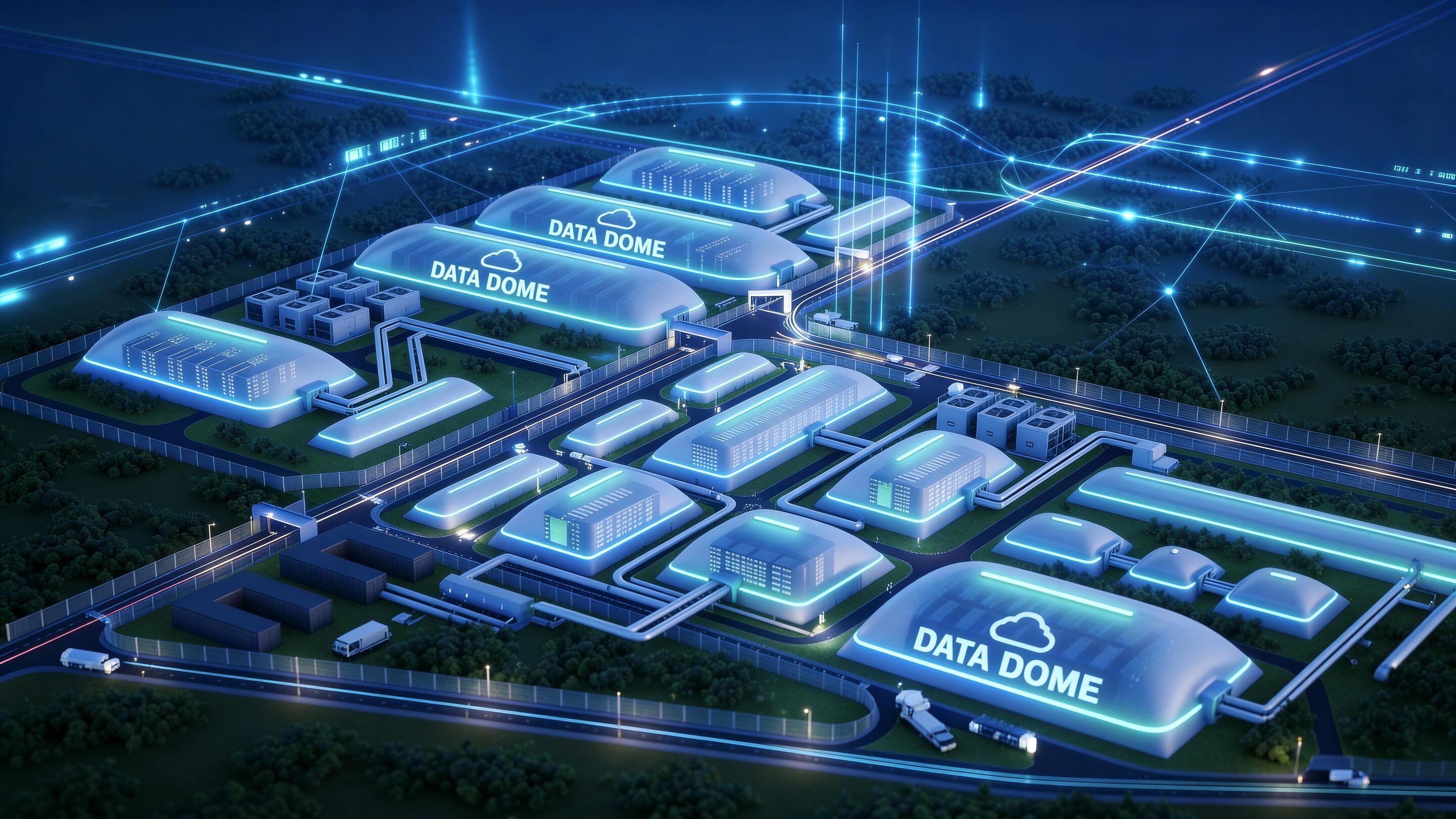
Request a CO2 Dome Concept & BudgetData centers are becoming major buyers of long-duration storage. A CCES plant can shift 8 to 10 hours of solar, wind or off-peak grid power into a data center's load, alongside the batteries, UPS and generators that handle fast response.
Our partner Exax has also developed a configuration that puts data center waste heat to work. During discharge, liquid CO2 must absorb heat to evaporate. Warm water from the data center's liquid-cooling loop can supply that heat and return to the data center cooler.
Scroll sideways to see the full diagram.
Two things set what that is worth on a given site.
The cooling effect happens only while the plant discharges, typically 8 to 10 hours a day, so it can be scheduled for peak-price or peak-heat hours but not around the clock.
It scales with the CO2 flowing through the evaporators, so the storage plant has to be sized for it.
Broadwell and Exax model each site hour by hour, using its load, coolant temperatures, climate and tariff, before anyone commits.
Pair it with a Broadwell air-supported data hall, and the building, the storage plant and heat rejection can be planned as one site.
Explore Air Dome Data CentersDiscover specialized air-supported building options tailored for industrial logistics, data centers, dedicated racquet hubs, and aquatic facilities.
Select the stage that best matches where you are in your facility planning journey.
Just Getting Started
Ready to learn the basics?
Explore Air Dome BasicsEvaluating Options
Ready to plan the purchase?
View the Purchase ProcessReady to Talk
Have these ready:
Ready to plan your project?
Request a CO2 Dome Concept & BudgetQuick answers on capacity, pressure, leak detection, durability and North American supply.
The low-pressure gas store in a compressed CO2 energy storage plant: a double-membrane, air-supported dome whose inner membrane holds the plant's CO2 as a gas and moves as the inventory changes.
Domes are sized to the plant. Larger plants use several domes; the 100 MW Mulei plant has five.
Slightly above atmospheric. The interspace blowers hold it steady as the plant charges and discharges.
A low-permeability inner membrane with factory-welded seams, sealed at the base, holds the gas. CO2 sensors in the interspace and around the dome, together with inventory tracking, alarm to the plant control system if concentrations rise.
Each dome is engineered for the wind, snow and seismic loads at its site, using ASCE 7 in the US and the National Building Code in Canada. The steel cable net carries those loads to the ring foundation.
Yes. Broadwell Air Domes supplies gas storage domes for North American CCES plants that use our partner Exax Energy Tech's technology, with drawings sealed by engineers licensed in the project's state or province.
Send us the plant rating, CO2 inventory, site and target operation date. We'll size the domes with Exax and come back with a concept, a budget range and an installation schedule.
Request a CO2 Dome Concept & Budget