Safety, Cost, Quality
Broadwell has over 400 operational domes around the world and has never had a catastrophic dome failure. This is due to the higher quality materials we use, our patented cable harness system, and our superior design and engineering.
Safety is our Top Priority
Broadwell has never had a catastrophic dome failure. Our domes are entrusted by Fortune 500 and Global 500 companies, governments, universities and colleges, professional athletic organizations, and many others. We are trusted with some of the most important projects in the world, including being tasked with protecting and preserving a 4,000-year-old excavated city.
Learn About Our Patented Cable Harness System- Wind loads, engineered to your local code
- Up to 150 mph
- Snow loads, engineered to your local code
- 50 psf
- Of wind and snow load carried by the steel cable net, not the fabric
- ~93%
Typhoon Mangkhut, September 2018, gusts up to 159 mph: all ten Broadwell domes in its path stayed operational.
Trusted by organizations such as
- Apple
- Microsoft
- Mercedes Benz
- McDonald's
Performance in Wind
Domes without a cable harness experience significant movement in wind, often causing interior hang lights to sway violently. The video shows this occurring on an unharnessed dome, alongside wind tunnel testing conducted on Broadwell's cable harness design.
How Do Our Domes Perform In Snow?Broadwell strictly follows the international codes for air inflated structures set forth by the International Code Council (www.iccsafe.org).
Our domes are engineered by licensed US and Canadian engineers, with P.E. and P.Eng. stamps available.
All fabric is lab tested for strength and tear resistance, and all have passed NFPA 701 fire certification.
We worked with a university to develop custom software that precisely calculates wind and snow loads for our domes.
Higher Quality Materials and Engineering
Broadwell uses thicker, stronger fabric both on the interior and exterior of the dome than what other dome companies typically provide. Our team of 50+ designers and engineers is the largest in the industry. We use state-of-the-art manufacturing equipment in the largest air dome manufacturing park in the world. Our expert designs and precise engineering allow us to create the very cleanest, smoothest possible fabric seams, connection points, and seals against the foundation and doors. Our superior engineering allows us to produce domes that have fewer creases and unsightly wrinkles in the fabric than any other domes in the world.
Broadwell fabrics are 30–45% thicker than many competitors’ standard dome fabrics.
Most Cost Effective
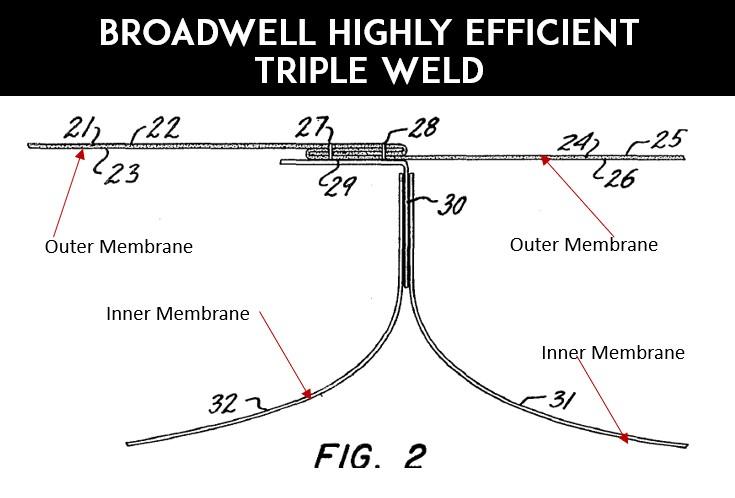
Broadwell is able to provide the most cost-effective domes in the industry, from both an up-front and ongoing operational standpoint. We design our domes with safety and efficiency in mind. Due to our triple weld fabric method, we have the most energy efficient domes in the world.
- Less to build than a permanent sports building
- 50–75%
- Higher R-value at every seam than a typical double-membrane weld
- 13×
Less Overhead
Broadwell's organizational structure minimizes overhead and streamlines our operations. Our operational costs are the lowest in the industry.
Cost-Effective Manufacturing
We have the largest manufacturing facility in the world with the most cost-effective and efficient manufacturing processes.
Lower Margin
The Broadwell mission is to provide the highest quality dome possible at the lowest price. We care about the ongoing success of our clients. We always give our customers the lowest price possible for the highest quality product.
Common Questions About Dome Safety
Quick answers on failures, wind and snow, power outages, fire, codes and monitoring.
No. Broadwell has never had a catastrophic dome failure. This is due to the higher quality materials we use, our patented cable harness system, and our superior design and engineering.
Domes are engineered to local code, up to 150 mph wind and 50 psf snow. The cable harness carries about 93% of the load, and the system raises pressure automatically in storms.
A backup blower with its own engine starts automatically, and generator options keep systems running. Even with a total loss of air, a dome deflates slowly, which is one reason interior objects stay at least 5 ft from the fabric.
Yes. Membranes meet NFPA 701 flame-resistance requirements, and all fabric is lab tested for strength and tear resistance.
Yes. Domes are designed to the IBC and IFC, and exit signs, emergency lighting and alarms follow your local fire code. Our domes are engineered by licensed US and Canadian engineers, with P.E. and P.Eng. stamps available.
Yes, as an option. Remote monitoring tracks pressure, temperature, outside wind speed, air quality and power use, and can call or text your team when a reading leaves its safe range.
Build Your Dome With a Proven Safety Record
Send us your location, intended use and approximate size. We’ll come back with a dome concept, a budget range and a schedule.
Get My Dome Estimate